Why Gen Z Deserves More Empathy at Work

- Employers can equip managers with emotional intelligence and mental health literacy to support employees as whole people, not productivity machines.
- Gen Z values transparency and accountability. Support their mental health through meaningful policy — not performative PR.
- Younger employees want to co-create their workplace. Try fostering cross-generational dialogue and creating space for feedback.
Vocal, values-driven and hyper-aware of their mental health, Gen Z is reshaping the workplace and expecting employers to keep up. Otherwise, they have no problem going elsewhere.
In forthcoming research from Indeed on today’s multigenerational workforce, most Gen Z workers admit they are either actively looking for a new job or open to new opportunities.1
“Gen Z workers are not quitting because they can not handle the workplace. They are quitting because the workplace was not built for them,” says licensed psychotherapist and educational content creator Dr. Courtney Tracy, also known as “The Truth Doctor” on TikTok and Instagram. In fact, McKinsey research reveals that Gen Z workers struggle with mental health issues and hostile work environments more than any other generation.
These young adults want comfort, autonomy and support — and they expect employers to deliver. I recently sat down with Dr. Tracy, who shared wellness-focused tips to bridge generational differences in the workplace.

Instantly match and connect with quality candidates
Learn moreNobody Wants to Work Anymore?
Gen Z gets a lot of bad press. It’s been called “the loneliest generation” due to high levels of depression and anxiety, while think pieces vilifying its work ethic constantly crop up online.
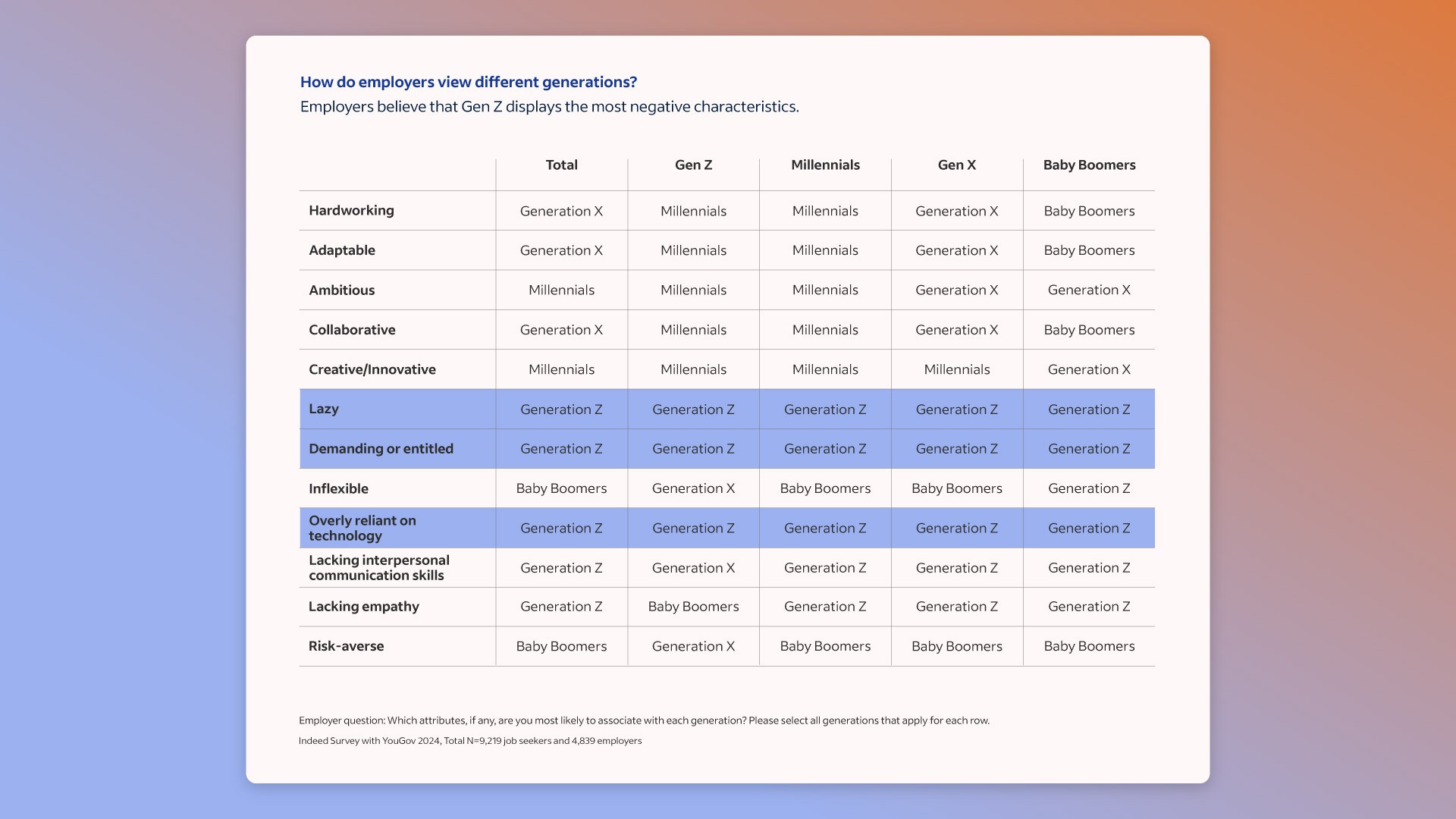
The employers and jobseekers surveyed in Indeed’s global talent report find just as much to critique. Every generation of survey respondents attributes negative traits — like being lazy, demanding, entitled and overly reliant on technology — to Gen Z. While older generations complaining about their younger counterparts is nothing new, Gen Z respondents surprisingly agree with these unflattering characterisations.1
So why all the negativity? “Every generation has gone through things, but not quite like Gen Z,” says Dr. Tracy.
She notes that the pandemic significantly impacted major life milestones, like not walking at graduation and experiencing college remotely, which affects identity and self-worth — and that is on top of the negative Gen Z depictions from virtually every direction.
Not to mention how hard it is to get a foot in the door nowadays. Recent college graduates are entering an uncertain job market with unreliable early career paths. Indeed’s economic research arm, Hiring Lab, finds that the number of internship postings have fallen from previous years on Indeed, settling below 2019 levels. Meanwhile, entry-level roles are primarily in-person jobs in lower-paying sectors like food service and sanitation.
“When someone carrying these stressors enters the workforce, there can be a disconnect between what they need and what employers expect from them,” says Dr. Tracy. Putting unrealistic expectations on those new to their careers or struggling mentally will only lead to demoralisation.
All in all, Gen Z workers are worthy of some understanding. “Do not just get upset at what they lack,” she continues. “Help them become what you need.”
Ways to Help Meet Gen Z Workplace Expectations
For employers, this is an opportunity. Supporting Gen Z means embracing a more human-centered future of work with empathy, equity and well-being embedded into leadership. Here’s how to get started.
1. Train managers to lead humans, not just monitor performance
In the U.K., young people struggling with their mental health are more likely to be out of work than their mentally well peers. Meanwhile, entry-level workers report lower satisfaction with their workplaces’ mental health support.
When managing a generation that’s hyper-aware of its mental health, surface-level perks will not patch over toxic culture or performative leadership. Dr. Tracy notices young adults look for wellness stipends, flexible work options and regular one-on-ones with managers to build real relationships. “Your Gen Z employees want to be seen as whole people, not just producers or checkboxes,” she says.
They thrive when their managers understand their personal goals and help build pathways for growth, she adds. That means shifting leadership training beyond KPIs to include emotional intelligence, mental health awareness and coaching skills.
And do not forget the managers themselves. “Today’s managers need to take care of their own mental health and that of their team. That is a different skill set,” Dr. Tracy points out. In addition to equipping people leaders through training, ensure they also have support systems.
2. Create opportunities for employee voice and influence
Dr. Tracy recalls when one of her Gen Z employee’s simple request to revamp the office’s coffee section invoked a larger change in attitude. Not only did the environment become homier, but workers were more comfortable using it to gather, connect and share ideas. As a plus, the employee who made the update was noticeably more confident.
“Gen Z wants to co-create their workplace,” says Dr. Tracy. “They do not just want to be seen — they want to be heard and to shape what comes next.”
Employers can create advisory boards, employee resource groups (ERGs) or leadership-shadowing programs to give younger employees a stake in shaping the workplace. Giving them ownership increases engagement and retention.
3. Bridge the generational gap with curiosity
Indeed's survey of the multigenerational workforce asks about the challenges of working with people across age ranges. Respondents most commonly cite differing communication styles and expectations as well as clashing views and opinions.1
Dr. Tracy compares it to group therapy. “I will have people from different ages coming from vastly different backgrounds all in the same room. I have to speak to each of them differently, but they find common ground because they are all there to grow,” she says. “We can see a workplace like group therapy; what’s the unifying goal to rally around?”
For a group that feels disproportionately isolated and lonely, the workplace can become a place for connection. What older leaders may see as oversharing, Gen Z may see as trust-building.
After all, respondents to the same Indeed survey say the greatest benefit of multigenerational workplaces is learning from each other.1 To better facilitate understanding, hold structured discussions across generations. When curiosity replaces judgment, collaboration follows.
4. Turn progress into something you can see and celebrate
With research demonstrating an overwhelmingly poor perception of Gen Z colleagues, it is not surprising that Gen Z does not feel fairly recognised or rewarded at work.
Dr. Tracy advises using growth visualisations to motivate a generation affected by so much negativity. “It is hard to counter negative thoughts with positive ones, but it is easier to see something positive when it's tangible and visible to others, too,” she says.
To be effective, any form of appreciation must feel genuine, not condescending. In our multi-generational survey, 37% of Gen Z respondents say their employers’ attempts at inclusive support come off as inauthentic, which impacts morale. Twenty-two percent say feeling that way causes them or their colleagues to put in minimal effort, and 20% actively start looking for another job.1
Strategies could be as simple as creating a physical chart demonstrating project progress. Some organisations offer “micro-promotions” that provide lower-stakes leadership opportunities, such as a mentor or project lead. Others incentivise upskilling programs with slight title changes to signify accomplishment, like progressing from Analyst I to Analyst II.
Look Past Gen Z Stereotypes at Work
As Dr. Tracy sums it up, “Gen Z is not lazy. They are just done sacrificing their mental health for a paycheck. And they are asking us to evolve."
The companies that do so will attract the next generation of talent and retain loyal, innovative, and empowered contributors.
Stay ahead of today’s workplace challenges and trends with Indeed’s latest studies and reports.
1Indeed Survey with YouGov 2024, Total N=9,219 jobseekers and 4,839 employers.
Indeed provides this information as a courtesy to users of this site. Please note that we are not your recruiting or legal advisor, we are not responsible for the content of your job descriptions, and none of the information provided herein guarantees performance.
Instantly match and connect with quality candidates
Learn more
Ready to get started?
Get insights and inspiration for the modern world of work
We’ll be in touch soon with the insights and inspiration you need to lead a thriving workforce.
Submit

